
How Much Does It Cost to Pour a Concrete Slab in Texas?
Published market guides put a plain concrete slab at about $4 to $12 per square foot. One national cost guide’s 2026 Houston page says most slabs there cost $4 to $8 per square foot. Its Houston range runs $3,550 to $7,099 per project. It calls the usual Houston job, about $5,324, right at the national average.
Another national guide’s 2026 figures put the average at $6 to $12 per square foot installed. That works out to $5,400 to $10,800 for a 30 by 30 foot slab. A slab foundation for a house costs more, because it is thicker and carries more steel.
These are market numbers, not our price list. Our concrete slab work covers slabs and pads for shops, barns, metal buildings and equipment on Houston’s northeast side.
What does a concrete slab cost per square foot?
Thickness changes the price. A thicker slab puts more concrete in every square foot. The national guide lists these installed averages.
| Slab thickness | Cost per square foot, installed |
|---|---|
| 4 inches | $6 to $8 |
| 6 inches | $8 to $10 |
| 8 inches | $10 to $12 |
The Houston page lists foundations at 8 to 10 inches thick and $12 to $18 per square foot. Labor runs $2 to $3 per square foot on the Houston page. The national guide puts it at $3 to $5.
Concrete itself is sold by the cubic yard. The national guide puts ready-mix at $119 to $147 a yard, with delivery within 20 miles. One yard covers about 81 square feet of a 4-inch slab. At 6 inches, a yard covers about 54 square feet.
What else moves the price of a concrete slab?
The per-foot prices above are mostly for the slab itself. Other lines can sit on top, and published guides price each one.
| Cost line | Published market range | Kind of source |
|---|---|---|
| Rebar | $0.50 to $1 per square foot | Houston page of a national guide |
| Rebar, with its labor | $1.40 to $4.00 per square foot | national guide |
| Leveling or regrading | $0.40 to $2.00 per square foot | national guide |
| Gravel base | $1 to $3 per square foot | national guide |
| Vapor barrier sheeting, material only | about 5 to 25 cents per square foot | concrete trade site |
| Trailer pump | $15 per cubic yard, $125 minimum | national guide |
| Boom pump truck | $140 to $190 per hour, 4 to 5 hour minimum | national guide |
| Short load, under 10 yards | $53 more per cubic yard | national guide |
| Plant more than 20 miles away | $9.50 more per mile | national guide |
Steel. The national guide says slabs over 4 inches thick often need rebar, mainly where heavy vehicles park. For a building, its plans set the steel.
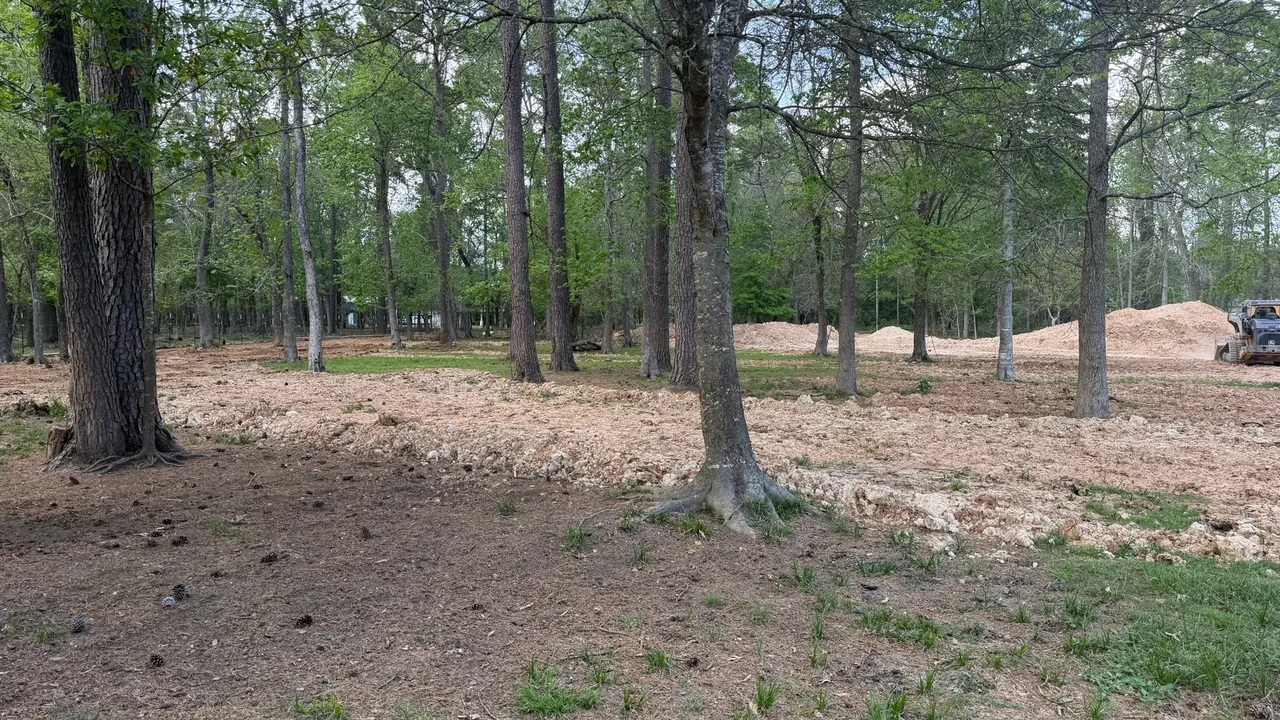
The pad. A slab is poured on a graded pad. On raw land, clearing and a raised building pad come first, and each is its own line on a quote.
The vapor barrier. This plastic sheet goes on the pad before the pour. It slows moisture that rises from the ground into the slab.
The pump truck. When the ready-mix truck cannot get close to the forms, a pump moves the concrete.
Access. The Houston page says steep slopes and many trees can raise the cost. Acreage far from a ready-mix plant can add a mileage charge.
The size. Small pours can cost more per square foot, because a short load carries an extra charge. A full 10-yard truck covers about 810 square feet at 4 inches thick.
What size slab does a shop or metal building need?
The building sets the slab size. The national guide’s metal building table runs from a 20 by 20 garage to a 40 by 60 building. A 30 by 30 workshop and a 30 by 40 barn sit in between.
This market math multiplies each size by the Houston range and the national range.
| Slab size | Square feet | At $4 to $8 per square foot | At $6 to $12 per square foot |
|---|---|---|---|
| 20 by 20 feet | 400 | $1,600 to $3,200 | $2,400 to $4,800 |
| 30 by 30 feet | 900 | $3,600 to $7,200 | $5,400 to $10,800 |
| 30 by 40 feet | 1,200 | $4,800 to $9,600 | $7,200 to $14,400 |
| 40 by 60 feet | 2,400 | $9,600 to $19,200 | $14,400 to $28,800 |
These rows are arithmetic on published ranges, not quotes. A shop that holds a tractor or a truck may need a thicker slab with more steel. The national guide says large slabs may need wire mesh, rebar, a vapor barrier or thicker edges.
The same guide puts a whole 30 by 40 metal building on a slab at $24,000 to $60,000. That figure leaves out site prep. We put up metal buildings on the slabs we pour, from the steel frame to the roll-up doors.
What does a slab foundation for a house cost?
A house slab costs more per foot than a shop floor. The national guide puts a slab foundation at $6 to $14 per square foot. Its average total runs $12,000 to $28,000. It says home foundations are typically 6 inches thick, with rebar and a vapor barrier.
The Houston page lists a 2,050 square foot home foundation at $36,900 on average. The two guides sit far apart, so read both as a rough range.
Why does Houston clay change the cost of a slab?
Much of the Houston area sits on heavy clay that locals call gumbo. The federal soil survey calls Lake Charles clay extensive in Southeast Texas, mainly between the Colorado and Trinity Rivers. It formed from Beaumont Formation clay.
When that soil dries, it cracks up to 2 inches wide and 12 inches or more deep. The survey says the cracks open and close one or more times a year. Federal soil guidance says shrinking and swelling like this can damage buildings and roads.
Soils change across the area, though. Around Humble, federal soil data shows mostly loamy and sandy ground, with pockets of clay subsoil that shrinks and swells.
The Houston page says the shrinking and swelling puts pressure on slabs and can lead to cracks. It points to rebar and stronger mixes for Houston slabs.
For a house, the residential code has a rule for this ground. Foundations and floor slabs on expansive soil must be designed for it, under section R403.1.8. A slab type with a good record on similar soil may be allowed, with the building official’s approval. Texas law adopts that code for homes inside Texas cities.
That design work can add an engineer’s fee and more steel to the price. Our new slab foundations page covers the house side. Your city or county permit office answers what a given lot needs.
What is the next step for a slab on your land?
Start with the slab’s size and what will sit on it. Plans for the building help, if you have them.
We grade the pad and set the forms. The vapor barrier and the steel go down, and then the slab is poured and finished.
SETX Construction works about 40 miles around northeast Houston. Call (888) 795-7757 for a free estimate, and we put the quote in writing. Our concrete slabs and pads page has more on the work.